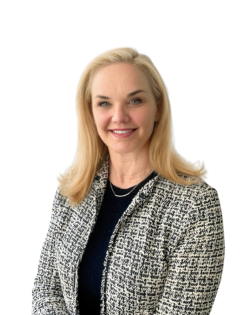
Anne Fischer, Ph.D., serves as Chief Technologist for the Deep Science Fund and Enterprise Science Fund at Intellectual Ventures (IV). She co leads the Funds, helping guide early-stage scientific efforts rooted in chemistry, physics, and materials science. In this role, she shapes technical strategy, mentors teams, and charts pathways for ideas at the edge of current understanding to potential real-world impact.
Anne is drawn to the space where fundamental science meets long term impact. She has built her career around understanding what is scientifically possible, how research evolves, and how early decisions shape future outcomes.
Her career reflects a consistent pull toward this big picture thinking. She spent more than 15 years working in the government research ecosystem, including senior leadership roles at the Defense Advanced Research Projects Agency (DARPA), where she served as Deputy Director of the Defense Sciences Office. There, she helped oversee high-risk, high-reward research portfolios spanning chemistry, materials, biology, and automation, while managing the uncertainty that accompanies frontier science. Hear Anne share a bit more about her time at DARPA in this LinkedIn post.
Anne’s interest in chemistry began early. Growing up in West Virginia, her curiosity was sparked at the kitchen table, experimenting with a chemistry set her mother encouraged her to explore. That interest deepened through high school and college, where she developed a particular appreciation for organic chemistry and its structured logic. At a small liberal arts college, a yearlong thesis project showed her what it meant to do science, asking hard questions and accepting uncertainty as part of the process.
Anne earned her Ph.D. in chemistry and briefly followed a traditional path early in her career, completing postdoctoral research at the U.S. Naval Research Laboratory before stepping into science policy through a AAAS Fellowship at the National Science Foundation. That experience proved pivotal. It showed her that she could remain deeply engaged with technical work while also thinking strategically about impact and transition.